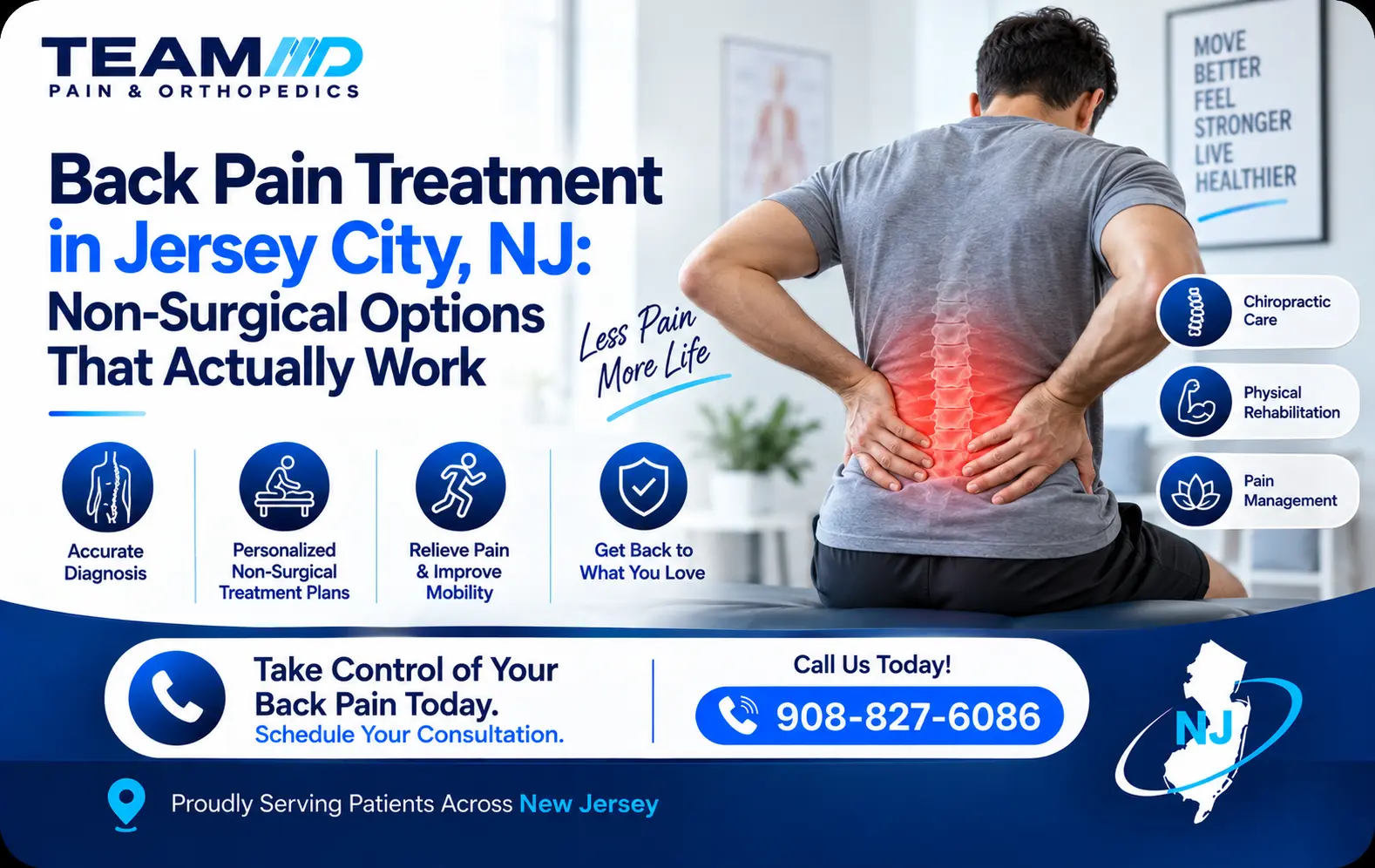
Back pain can range from a temporary muscle strain to pain associated with a herniated disc, sciatica, nerve irritation, arthritis or another spinal condition. Because the cause can vary, back pain treatment in Jersey City, NJ should begin with an evaluation rather than assuming that one treatment will work for everyone.
At TeamMD, treatment is based on the suspected source of pain, your symptoms, physical findings and functional goals. Depending on your condition, our pain management treatments in NJ may include physical therapy, chiropractic care, medication management, targeted injections, nerve blocks, radiofrequency ablation and other pain-management approaches — each selected to match your specific diagnosis rather than applied as a one-size-fits-all protocol.
What Is the Best Non-Surgical Treatment for Back Pain?
There is no single best treatment for every type of back pain. The appropriate approach depends on what is causing the pain and whether symptoms involve muscles, joints, discs or nerves.
For example:
| Back pain pattern | Treatment approach may include |
|---|---|
| Muscle strain or mechanical pain | Physical therapy, movement and posture strategies, chiropractic/manual care |
| Persistent low back pain | Evaluation, physical therapy, lifestyle strategies and individualized pain management |
| Pain radiating into the leg | Evaluation for nerve involvement; physical therapy or targeted pain treatment may be considered |
| Herniated-disc-related symptoms | Conservative care, physical therapy and, when appropriate, targeted injections |
| Facet-related back pain | Diagnostic evaluation, nerve blocks and potentially radiofrequency ablation |
| Chronic pain that has not improved with conservative care | Additional pain-management options based on the diagnosis |
The goal is not simply to reduce pain for a few hours. A treatment plan should also consider mobility, function and the underlying condition.
What Causes Back Pain?
Back pain can have many causes. TeamMD’s low back pain resources identify conditions and factors including muscle or ligament strain, herniated or bulging discs, degenerative disc disease, sciatica, poor posture, sedentary habits, sports injuries and accidents.
Pain may also be described differently depending on the underlying problem.
Mechanical back pain
Mechanical pain may be related to movement, posture, muscle strain or other structures involved in movement.
Sciatica and nerve-related pain
Sciatica can cause pain that travels from the lower back into the buttock or leg. Numbness, tingling or weakness can indicate nerve involvement and should be evaluated.
Disc-related pain
A bulging or herniated disc can sometimes irritate or compress a spinal nerve, potentially causing back pain and symptoms that travel into the leg.
Because these conditions can produce overlapping symptoms, identifying the likely source is an important part of treatment planning.
How Is Back Pain Diagnosed?
A back pain evaluation generally starts with your symptoms and medical history.
At TeamMD, evaluation may include:
- Review of your medical and pain history
- Physical examination
- Assessment of posture and mobility
- Evaluation of neurological symptoms when appropriate
- Imaging such as X-rays or MRI when clinically indicated
- Additional testing in selected cases
TeamMD’s low back pain program specifically emphasizes identifying the cause before recommending a treatment or procedure.
Imaging is not automatically necessary for every person with back pain. Clinical guidelines recommend that imaging decisions be based on the patient’s presentation and whether the results are likely to change management.
Non-Surgical Back Pain Treatment Options in Jersey City
Once the likely cause of your pain has been identified, your provider can determine which pain management treatments in NJ make sense for your condition.
1. Physical Therapy
Physical therapy can help people improve strength, flexibility, mobility and movement patterns associated with back pain.
TeamMD’s Jersey City physical therapy program uses individualized treatment plans that may include:
- Therapeutic exercise
- Strengthening
- Mobility training
- Manual therapy
- Movement education
- Post-operative rehabilitation when appropriate
For back and neck pain, TeamMD’s physical therapists evaluate contributing factors and develop treatment around the patient’s diagnosis and functional goals.
For chronic primary low back pain, the World Health Organization recommends interventions such as education and exercise, along with certain physical therapies, depending on the individual situation.
2. Chiropractic Care
Chiropractic care may be appropriate for certain mechanical musculoskeletal problems.
TeamMD’s Jersey City chiropractic program begins with an assessment of your health history, symptoms, movement and posture. Treatment may include:
- Spinal manipulation
- Joint mobilization
- Soft-tissue therapy
- Corrective exercises
- Posture and lifestyle guidance
- Home exercises
Chiropractic care should not be presented as a universal solution for every type of back pain. The appropriate approach depends on the diagnosis and individual circumstances.
3. Medication Management
Depending on your condition and medical history, medication may be one component of a broader back pain treatment plan.
Medication decisions should be individualized by a qualified healthcare professional. They may take into account your diagnosis, other medications, medical conditions and the potential benefits and risks of treatment.
Medication is generally better viewed as one part of a broader plan rather than the entire solution.
4. Epidural Injections
Epidural injections may be considered when inflammation around spinal nerves contributes to symptoms.
TeamMD describes epidural injections as a treatment that delivers medication near the spinal nerves to help reduce inflammation. Its pain management services identify conditions such as herniated discs, radiculopathy and certain forms of lower back or leg pain as situations in which epidural injections may be considered.
They are not appropriate for every type of back pain.
For example, NICE recommends considering epidural injections with local anesthetic and steroid for acute and severe sciatica, while recommending against using spinal injections simply as a general treatment for low back pain.
5. Nerve Blocks
A nerve block uses an injection to target a specific nerve or group of nerves associated with pain.
At TeamMD, nerve blocks may be used for conditions involving back pain, nerve pain, joint pain and facet-related pain. They can have both a therapeutic and diagnostic role depending on the clinical situation.
This can make nerve blocks particularly useful when your provider is trying to determine whether a particular nerve or pain-generating structure is contributing to your symptoms.
6. Radiofrequency Ablation
Radiofrequency ablation, or RFA, uses radiofrequency energy to disrupt pain signals from selected nerves.
TeamMD identifies RFA as an option for certain chronic pain conditions, including facet-related pain and some neck and low-back pain. The procedure may be considered when other treatment has not provided sufficient relief and diagnostic blocks indicate that a particular nerve is contributing to the pain.
RFA is not a first-line treatment for every person with back pain.
For appropriately selected patients with chronic low back pain, NICE recommends assessment for radiofrequency denervation after non-surgical treatment has not worked and when the suspected pain source is associated with medial branch nerves and diagnostic testing supports the approach.
7. PRP Injections
Platelet-rich plasma (PRP) injections use a concentrated portion of a patient’s own blood components.
TeamMD offers PRP as a regenerative treatment and describes its use for certain joint, tendon and soft-tissue conditions. Whether PRP is appropriate depends on the tissue involved and the diagnosis.
PRP should therefore be presented as a condition-specific option, not as a treatment that automatically works for all forms of back pain.
When Should You See a Back Pain Specialist?
Consider an evaluation if your back pain:
- Keeps returning
- Interferes with work or everyday activities
- Travels into the buttock or leg
- Causes numbness or tingling
- Is associated with weakness
- Does not improve with appropriate self-care
- Becomes progressively worse
- Develops after an injury or accident
Back pain accompanied by certain symptoms requires more urgent medical evaluation.
When Is Back Pain an Emergency?
Seek urgent medical attention for back pain associated with new bowel or bladder control problems, significant or worsening weakness, fever, or serious trauma. These symptoms can sometimes indicate a condition requiring prompt evaluation.
Does Back Pain Always Require Surgery?
No. Surgery is not automatically the next step when back pain persists.
The appropriate pathway depends on the underlying condition, severity of symptoms, neurological findings, functional limitations and response to non-surgical treatment.
Some patients can be managed with rehabilitation, physical therapy, chiropractic/manual care, medication management or targeted pain-management procedures. Other conditions may eventually require an orthopedic or spine-surgery evaluation.
TeamMD’s Jersey City location includes pain management and access to orthopedic and spine-related services, allowing treatment decisions to be based on the patient’s individual condition rather than assuming that every case requires the same approach.
Why Choose TeamMD for Back Pain Treatment in Jersey City?
TeamMD’s Jersey City location provides access to pain-management care, physical therapy and chiropractic services, allowing patients to be evaluated through different areas of musculoskeletal care. As a trusted provider of pain management treatments in NJ, our team builds every plan around your diagnosis rather than a generic protocol.
The Jersey City pain-management team highlights:
- Experienced pain specialists
- Personalized treatment plans
- Modern diagnostic technology
- Minimally invasive procedures
- Patient-centered care
Frequently Asked Questions
What is the best treatment for back pain?
There is no single treatment that is best for everyone. Treatment depends on the cause of pain, symptoms, duration, nerve involvement and overall health. Options may include physical therapy, chiropractic care, medication management and targeted pain-management procedures.
Can back pain be treated without surgery?
Many back-pain conditions can be managed without surgery, depending on their cause and severity. Non-surgical options may include exercise-based rehabilitation, physical therapy, manual therapy, medication management and selected minimally invasive procedures.
When should I see a doctor for back pain?
Consider medical evaluation when pain persists, interferes with daily activities, travels into the leg, causes numbness or weakness, or develops after an injury. Emergency evaluation is appropriate for symptoms such as new bowel or bladder problems or significant neurological changes.
Is physical therapy good for lower back pain?
Physical therapy can be useful for many people with back pain because treatment can address strength, mobility, flexibility and movement limitations. TeamMD develops individualized physical therapy programs based on the patient’s condition and functional goals.
Can chiropractic care help back pain?
Chiropractic care may help some people with mechanical musculoskeletal back pain. TeamMD’s Jersey City chiropractic program uses assessment, spinal manipulation, joint mobilization, soft-tissue techniques and corrective exercises when appropriate.
When are epidural injections used for back pain?
Epidural injections may be considered when inflammation or irritation around spinal nerves contributes to symptoms, such as certain cases of sciatica or disc-related pain. They are not appropriate for every type of back pain.
What is radiofrequency ablation for back pain?
Radiofrequency ablation uses radiofrequency energy to disrupt pain signals from selected nerves. It may be considered for certain chronic back-pain conditions after appropriate evaluation and diagnostic testing.
How does TeamMD determine the right treatment?
TeamMD evaluates your symptoms, medical history and physical findings and may use imaging or other diagnostic testing when appropriate. The resulting treatment plan is based on the suspected cause of your pain, your functional needs and your response to previous treatment.
Get Back Pain Evaluated in Jersey City
Persistent back pain does not have to be approached with a one-size-fits-all treatment plan.
At TeamMD Jersey City, the first step is understanding what may be causing your symptoms. Depending on your condition, treatment may involve physical therapy, chiropractic care, medication management, injections, nerve blocks, radiofrequency ablation or other pain management treatments in NJ.
Schedule a back pain evaluation with TeamMD in Jersey City to discuss your symptoms and treatment options.